


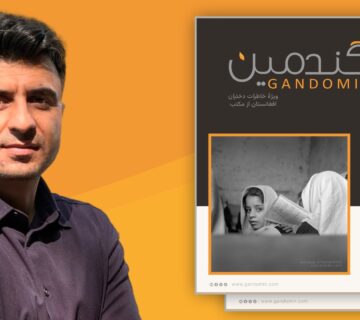
The second issue of the magazine Gandomin begins at a specific turning point: August 15, 2021 (24 Asad 1400)—a day that marked the onset of a new era of deprivation, fear, uncertainty, and the loss of hard-won achievements for many Afghanistani women. Looking beyond high politics and monumental historical events, this issue focuses on the lived realities of women who experienced the fallout inside their homes, schools, universities, workplaces, and in exile.
Memory and personal narrative form the core of this issue. It operates on the conviction that history is not solely confined to official textbooks, political reports, and statistics; a vital portion of history lives in personal memories, family photographs, school notebooks, abandoned homes, packed suitcases, and the silence of those who had stories to tell but lacked the platform to voice them. Consequently, Gandomin turns to everyday, personal accounts to offer a more human portrait of what Afghanistani women have endured.
This edition compiles sixty narratives and memoirs, juxtaposing the two eras of Taliban rule to capture the lived experiences of two generations. A central theme highlighted in the editorial foreword is the continuity between these eras: women who spent their childhood and youth under restrictions during the 1990s now watch their daughters and granddaughters face an identical reality. The issue illustrates that this crisis is not merely the return of a political regime, but the generational recurrence of an inherited fate.
The narratives are organized into five thematic sections:
- Hereditary Wounds: Explores experiences rooted in the past, capturing the voices of women who previously navigated deprivation, fear, migration, imprisonment, restrictions, and resistance. This section shows that present agonies are often old wounds reopening, documenting paths redirected from education and careers toward domestic confinement, exile, or underground resistance—yet undercurrents of resilience, reconstruction, and hope persist.
- The Day of the Fall: Focuses closely on the moment of collapse and its immediate aftermath. Women recount the fall as it unfolded across streets, homes, educational centers, and daily routines. For some, it marked the end of an era; for others, the beginning of flight, displacement, and separation. Titles such as “Do Not Believe It,” “From That Evening Onward,” “Kabul, Across the Waters,” “The Cot of Sorrow,” and “The Day Our Hopes Collapsed Along with Kabul” ground a major geopolitical rupture in private life.
- Behind Closed Doors: Shifts the perspective inward to the domestic sphere. This section examines lives maintained behind closed doors: interrupted dreams, lost years, girls barred from education, and women confined to the home. Yet the home emerges as a site of quiet resistance—a space where learning, writing, critical thought, connection, and ambition are sustained in new forms.
- Geographies of the Inevitable: Follows the journey beyond homes and cities across borders into foreign lands. It details migration through the lenses of statelessness, lost identity, separation from family, rebuilding from scratch, and preserving past attachments. Narratives such as “The Border Between Me and My Homeland,” “Statelessness: A Purgatory Between Being and Non-Being,” “From Kabul to Tehran and Islamabad,” and “Amid Borders and Foreign Lands” convey how the collapse often stripped away the very meaning of home.
- Silence: Forms perhaps the heaviest chapter, framing silence itself as a distinct mode of storytelling. It captures women who spent years under systemic restrictions, documented underground resistance networks, and belonged to a generation stripped of its youth while still safeguarding hope for the future. Concluding deliberately with the piece “Hope Still Exists,” Gandomin refuses to reduce the Afghanistani woman’s narrative strictly to suffering and defeat.
A defining strength of this issue is its intersection of diverse ages, backgrounds, and geographies—ranging from an adolescent whose childhood was interrupted by political upheaval to an elder who lived through the first Taliban regime; from women remaining inside Afghanistan to those forced into exile. These varied perspectives converge on a shared reality: enduring a landscape where state political decisions intrude directly into the most intimate facets of personal life.
The accompanying photographs serve as essential historical artifacts. An image of a school, a home, or a portrait preserves vital context that risks erasure in official state histories.
Ultimately, the second issue of Gandomin documents history as told by those who bore the consequences of power, rather than by political rulers. While these sixty accounts do not claim to capture the entirety of Afghanistan’s complex reality or represent every woman, each serves as a vital fragment of collective memory. As long as these testimonies are recorded and read, the lived experiences of the people remain shielded from forced silence and political denial.


No comment