
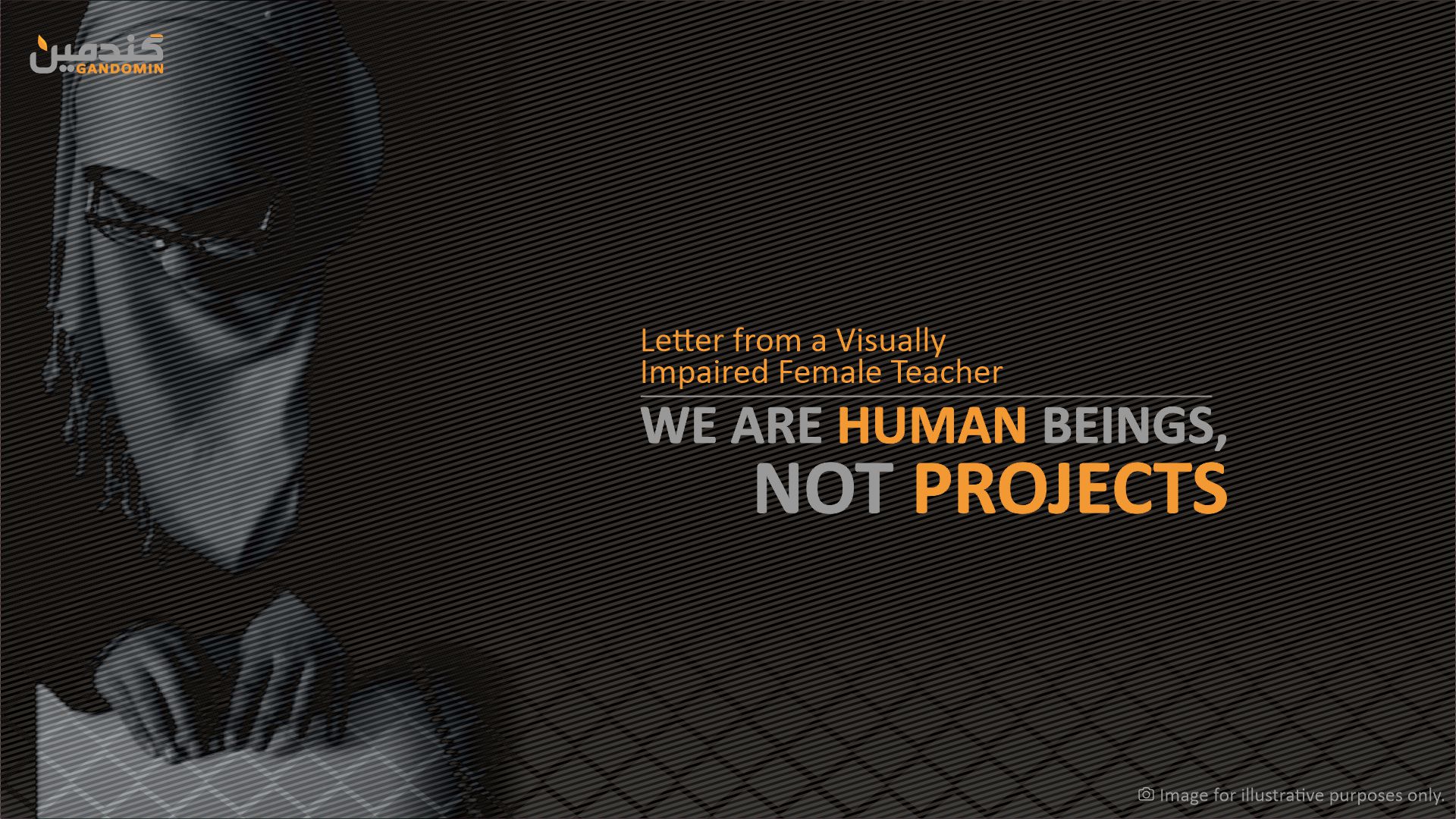
To those who claim to defend the rights of blind people; to the international community, the United Nations, and human rights organizations:
In the name of God, who, if He deprives a human being of sight, does not deprive them of their heart, voice, or dignity!
To you, self-proclaimed defenders of human rights! To the international community! To the United Nations! To human rights organizations! To the institutions that have, for years, repeated the words “rights of persons with disabilities” in reports, conferences, and declarations:
As-salamu alaykum wa rahmatullahi wa barakatuh! (Peace, mercy, and blessings of God be upon you!)
I am a blind woman—a teacher at the Kabul Institute for the Blind (Rawshandilan)! A woman who cannot see the world with her eyes, yet for years has seen so much that those with sight fail to perceive.
I know darkness! But believe me, the darkness of the eyes is nowhere near as terrifying as the darkness of the human conscience! I have one question for you: Where is the voice of the forgotten generation of persons with disabilities, especially those who are visually or hearing impaired in Afghanistan? Have you not heard our cries yet? Or have you heard them and chosen to turn a deaf ear?
Perhaps your reports are filled with elegant phrases like “inclusion,” “disability,” “human rights,” “equal access,” and “empowerment”; but we, the visually impaired of Afghanistan, can not live on these words! We live with unemployment! We live with fear, with deprivation, with closed doors, and with a future that shrinks with each passing day.
Blindness is not merely the inability to see the color of the sky! When a visually impaired person is stripped of the opportunity to work, denied an education, robbed of financial independence, and when society slams its doors in her face due to both her gender and her disability—then it is no longer just her eyes that are blind; society itself has blinded her to the possibility of a future!
I ask you: If you are aware of the plight of Afghanistan’s visually impaired, what is your stance? If you know that visually impaired teachers and staff are facing unemployment and severe job insecurity, what will you do? If you are aware of visually and hearing-impaired girls being barred from education, which door will you open for them? If you know that during these years under Taliban rule, twenty visually impaired staff members were dismissed—an unprecedented act compared with previous periods—why have we not heard your voice in protest?
Does a blind person cease to have “human rights” the moment they lose their livelihood? Are human rights reserved solely for the days when posing for a photo with a blind person serves well in an annual report or at an international conference?
Perhaps silence is safer for some! But for the victim, the silence of others is at times far more agonizing than the violence itself.
We do not ask you to become our heroes! We do not want our names stamped on your projects! We do not want the suffering of the visually impaired to be exploited to secure budgets, funding, prestige, seats, titles, and professional status.
We are not projects; we are human beings! We are not statistics to be cited at the end of a report! We are not pictures to be printed in an organization’s brochure! We are not stepping stones for others to climb over our pain and reach higher positions!
We are women and men who want to work, who want to study, who want to teach, who want to earn our bread with our own hands. We want an Afghanistani visually impaired girl to be able to touch the pages of her books and know that her future has not already been written for her in despair.
Yet today, it often feels as though for some, a silent blind person is far more desirable than one who demands their rights! A blind person who stays silent is good! A blind person who poses for a photo is good! A blind person who speaks of “empowerment” in a staged event is good! But a blind person who asks: “Why did you take my job away?”, “Why are you depriving visually impaired girls of education?”, “Why was violence inflicted upon my blind colleague?”, “Where is my safety?”, “Where are my rights?”—suddenly becomes troublesome!
O champions of human rights! If you only hear our voices when doing so costs you nothing, yyou are merely selective listeners to our suffering.
True defense of human rights does not mean delivering speeches on human dignity in luxurious halls! True defense begins on the day when standing up for a human being carries a cost for the defender.
Today, a visually impaired worker loses their job; tomorrow, it could be another teacher! Today, a visually impaired girl is barred from education; tomorrow, it could be another girl! Today, our colleague lives in fear of violence; tomorrow, it could be my turn!
And tomorrow, it may be your turn to be held accountable: Where were you when these human beings needed your help?
I am a blind woman! My eyes may not see the buildings of the United Nations! I may not see the faces of the officials delivering speeches about our rights! But there is one thing I understand deeply: sincerity is not perceived with the eyes; it is measured by actions!
So if you are truly advocates for the rights of the visually impaired, please be our voice today, not tomorrow! Not in the next report! Not at the next conference! Not in a ceremonial statement!
Today, be the voice of the visually impaired teacher who has been thrown into unemployment! Be the voice of the visually impaired worker who has lost all job security! Be the voice of the visually impaired girl demanding her right to education! Be the voice of the visually impaired colleague who fears violence and its repercussions! And be the voice of thousands of visually impaired individuals who, silenced by fear, poverty, and deprivation, do not even possess the strength to cry out.
We do not ask you for miracles! Just do not let your silence normalize our agony! And if you have ever truly been the voice of the visually impaired of Afghanistan, do not keep our voices confined to your rooms this time—carry them to the ears of the world!
My Appeal to the Media
To you—journalists, media outlets, and writers of Afghanistan and the world—I make a deeply human appeal: If this letter is worth hearing, please share it responsibly and with integrity!
I do not ask you to take sides! I do not ask you to pass judgment! I only ask that you do not censor our voices and do not relegate the suffering of the visually impaired to the margins!
If an allegation warrants scrutiny, investigate it! If an official ought to be held accountable—though I am completely certain they will never answer—try to demand answers from them! If a right has been trampled, listen to the victim’s account! If we are mistaken, investigate and bring the truth to light for the public. But do not allow the voice of a visually impaired woman to be lost in the dark simply because her eyes cannot see the cameras and the podiums!
Media! You may be the only window through which this voice can reach beyond the darkness. If you find it worthy, please share this letter respectfully: not to spread hatred, not to incite violence, but so that the voice of a disenfranchised community is heard!
We ask for nothing more than the right to be heard! We ask for nothing more than the right to live with dignity! We ask for nothing more than the rights to education, work, security, and independence!
And perhaps the greatest plea of a blind person to a world that claims to defend their rights is simply this:
See us—even if we cannot see you!
With respect,
and with a heart laden with pain.


No comment