

Introduction
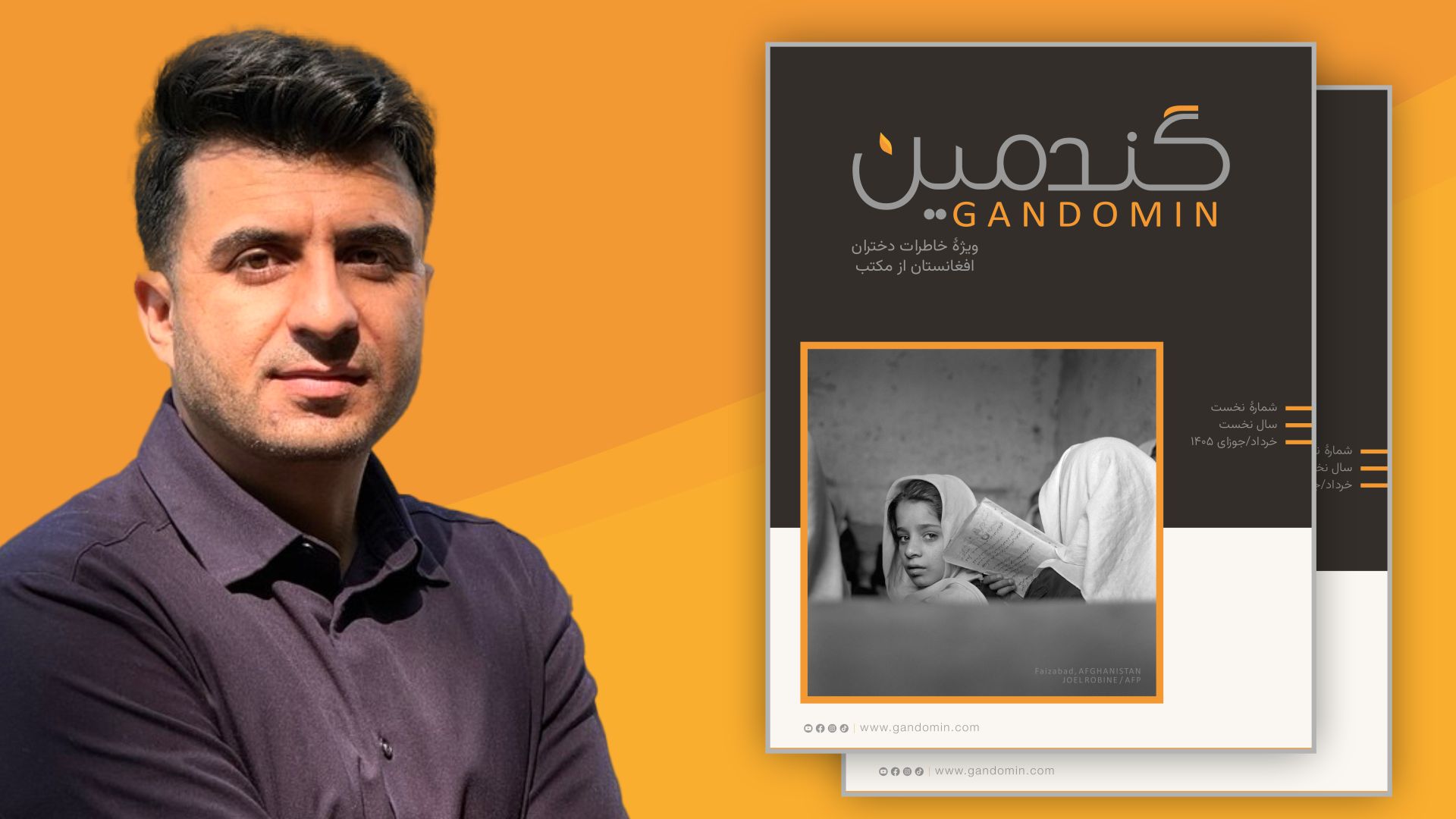
In its inaugural issue, Gandomin magazine compiled and published Seventy Memoirs of Afghanistan Girls, spanning nearly seven decades—from 1951 to 2021. These memoirs appear at a time when Afghanistan has become the only country in the world where girls are systematically denied access to education, employment, and the possibility of living an ordinary life.
In such circumstances, writing is no longer a matter of leisure or merely an artistic pursuit. It becomes an act of defiance against silence and forgetting; a stand against denial; and a form of cultural resistance to oppression, ensuring that neither the suffering of this captivity nor the dignity of this steadfastness is erased from our collective history.
This article reviews and analyses these memoirs through three principal themes: (1) the shortcomings of Afghanistan’s educational system, (2) the nostalgia and beauty of school life, and (3) the structural characteristics of the memoirs themselves.
Before proceeding, I would like to express my sincere appreciation to the editorial team of Gandomin. By collecting these memoirs, they have preserved a living archive of Afghanistan girls’ educational experiences and launched a significant cultural resistance against the Taliban’s policy of erasure.
School Memoirs: Narrating Educational Experience and Their Historical Significance
Memoir writing is far more than the simple recollection of past events. It represents a dialogue between the present self and the former self—a reconstruction of lived experience through memory. School memoirs constitute a distinctive literary genre in which educational spaces become central to the narrative. Through personal experience, the educational system itself emerges as both a setting and an active presence, viewed through the lived realities of students.
The importance of school memoirs can be understood on three interconnected levels: the individual-psychological, the historical-social, and the cultural-political.
At the individual and psychological level, memoir writing helps individuals process educational trauma and reinterpret painful experiences. It allows former students to revisit wounds that may have remained unresolved and to assign new meaning to those experiences.
At the historical and social level, these memoirs create a uniquely female archive of education. They reconstruct an unwritten history of girls’ schooling in Afghanistan, documenting experiences that have rarely been preserved in official records.
At the cultural and political level, memoir writing becomes an act of resistance. It challenges policies of erasure by preserving memories that authoritarian regimes seek to eliminate. In doing so, personal narratives are transformed into instruments of cultural resilience.
The memoirs collected by Gandomin portray school as a profoundly dualistic space. On one hand, it is depicted as a site of repression—marked by punishment, humiliation, and inequality. On the other, it appears as a sanctuary of dreams, friendship, playfulness, and the joy of learning.
This duality distinguishes school memoirs as a unique genre within autobiographical literature. Understanding them requires an interdisciplinary perspective that brings together the sociology of education, educational psychology, and literary criticism.
- Diagnosing Afghanistan’s Educational System Through Seventy Memoirs
The educational system portrayed across the seven decades covered by these memoirs has never been a uniform or static institution. From the comparatively well-equipped schools and more open educational environment of the 1960s, to the tent schools and resource-deprived classrooms of the war years; from the underground schools of the first Taliban regime to online learning during the COVID-19 pandemic and its aftermath, Afghanistan’s education system has continuously existed at the intersection of educational aspirations and political repression.
The memoirs vividly capture these contradictions. They reveal recurring structural deficiencies that have persisted across different historical periods. The following sections examine some of the most significant of these systemic challenges.
1.1 Healthy or Unhealthy Competition? A Duality That Was Never Resolved
Competition is, by nature, a powerful driver of learning. Yet when it develops within an environment marked by scarcity of opportunity and an obsession with grades, it can easily become a source of anxiety and a mechanism of humiliation.
Several memoirs present competition as a positive and mutually inspiring force. The Gandomin collection reflects both sides of this reality.
One narrator, who attended Rabia Balkhi High School during the 1960s, recalls her friendly academic rivalry with classmates Jamila, Najiba, and Afifa:
“Despite our competition, we remained close friends. We worked together, struggled together, and even protested together.”
Here, competition fostered solidarity rather than hostility.
Many other memoirs, however, describe competition as a source of emotional injury and damaged self-worth.
Arya Aryan recounts a memory from the second grade. Excited to wear her small gold earrings to school, she proudly arrived expecting a joyful day. Instead, when her name was announced as second in the class rankings, she recalls:
“I didn’t speak a single word all the way home. When I arrived, I quietly took off my earrings with a sadness I could not explain.”
In this account, competition ceases to be a motivation for excellence and instead becomes an existential defeat.
Even success could become psychologically burdensome.
Touba remembers becoming the top-ranked student in her first-grade class:
“When I came first, a new conflict began. Saba refused to accept that my name should be called before hers during attendance.”
Eventually, the teacher attempted to resolve the dispute by declaring that both girls were first in the class.
Competition had evolved into a struggle over status rather than a pursuit of learning.
These memoirs suggest that competition within Afghanistan’s educational system can only be considered healthy when teachers encourage students to focus on personal growth rather than attaching permanent identities to academic rankings. Unfortunately, in many cases—particularly in a context where girls did not enjoy equal educational opportunities—competition became another mechanism through which inequality was reproduced.
1.2 A Grade-Centred System: Reproducing an Unhealthy Culture of Elitism
One of the most recurring and damaging characteristics of the educational system described in these memoirs is the rigid classification of students into categories such as first, second, and those left behind.
Such ranking did more than assign academic positions; it imposed lasting psychological labels and, in some instances, reinforced broader social and ethnic hierarchies.
Suraya Baha recalls being selected as the top student in her class, editor of the school newspaper, and chair of a Model United Nations conference at Zarghona High School.
Yet these distinctions offered her no protection from public humiliation.
When she invited members of the royal family to speak and they remained silent, the school principal publicly accused her of being rude and ill-mannered, threatening her with a stick.
Ironically, her status as an outstanding student became an additional reason for criticism, as greater obedience and perfection were expected from those who excelled academically.
Another memoir illustrates the lasting psychological consequences of constant comparison.
Zohra Mayel, who studied at Malalai High School in Kabul, writes candidly:
“For that reason, I never managed to become the first-ranked student. Until I graduated, I remained second behind my dear classmate Najia.”
Although written years later, her words still carry the quiet disappointment of an ambition that never fully healed.
Collectively, these memoirs reveal how Afghanistan’s grade-centred educational culture taught students to equate personal worth with numerical rankings.
Students internalised the belief that unless they were first in the class, they somehow remained incomplete.
1.3 The Mosque as a Substitute for School
It is important to acknowledge that throughout Afghanistan’s history and culture, mosques have fulfilled functions extending well beyond religious worship. They have long served as centres of community life, moral education, and the preservation of religious identity.
The problem highlighted in these memoirs is therefore not the mosque itself.
Rather, it is the substitution of mosque-based religious instruction for formal schooling, and the assumption that several hours of Qur’anic reading could replace the comprehensive education provided by the first years of primary school.
Several memoirs describe girls who, simply because they had attended Qur’anic classes at a mosque, were permitted to enrol directly in third grade without completing the first two years of school.
Azita Kakar, recalling her childhood in Herat, writes:
“My sister and my cousin were seven years old. They enrolled directly in Grade Three because everyone said that, having already attended the mosque, they had effectively completed Grades One and Two.”
Such practices overlooked the fundamental distinction between the educational roles of mosques and schools.
While mosques play an invaluable role in religious instruction, Qur’anic recitation, and moral formation, they are not designed to provide systematic instruction in mathematics, science, language, history, or other academic disciplines taught over several hours each day in primary schools.
Schools introduce children to foundational concepts such as numbers, measurement, causality, and time while cultivating analytical reasoning and problem-solving skills.
Replacing formal education with mosque attendance therefore produced several harmful consequences.
First, it created substantial gaps in foundational knowledge. Religious instruction, however valuable in its own sphere, could not substitute for literacy, numeracy, and scientific learning.
Second, it reproduced educational inequality. Girls promoted directly to third grade frequently lacked the academic preparation possessed by classmates who had completed two full years of formal schooling.
Third, the practice encouraged credentialism rather than genuine learning. Families often became more concerned with advancing quickly to higher grades than with ensuring meaningful educational development, treating mosque attendance as a shortcut rather than recognising the distinct educational purposes served by each institution.
1.4 Placement Examinations: Superficial Promotion Without Academic Foundations
Numerous memoirs describe placement examinations that allowed students to advance to higher grades despite lacking adequate academic preparation.
Often introduced because of limited educational resources, family pressure, or interrupted schooling, these examinations promoted students through the system while bypassing essential learning.
Rather than strengthening education, they contributed to superficial certification and weakened academic foundations.
A student could move into the next grade after passing a brief, often poorly standardised examination, despite missing an entire year’s worth of structured learning.
Across the past seven decades, Afghanistan’s educational system has faced profound structural challenges: prolonged conflict, inadequate infrastructure, shortages of qualified teachers, and deep gender and regional inequalities.
Consequently, literacy and numeracy rates frequently remained below expected standards, and many students completed years of schooling without mastering basic reading, writing, or arithmetic.
Within this context, placement examinations functioned less as educational support mechanisms than as factors that intensified an already fragile system.
1.5 Politicisation and the Imposition of Ideology: The Suppression of Critical Inquiry in the Educational System
The relationship between political ideology and education is neither unique to Afghanistan nor inherently problematic. Across the world, educational systems inevitably reflect the cultural, political, and philosophical values of the societies in which they operate.
For example, education in the United States generally promotes the ideals of liberal democracy, individualism, and entrepreneurship. The Scandinavian countries emphasise social equality, civic participation, and collective welfare. China’s curriculum is closely aligned with socialist principles and loyalty to the Communist Party. In many Muslim-majority countries, educational programmes are developed around Islamic teachings and moral values. Israeli education is intertwined with Jewish identity and Zionist narratives, while in Buddhist-majority countries such as Thailand and Sri Lanka, Buddhist teachings are incorporated into school curricula. Likewise, in many Christian countries, religious education forms part of the formal educational programme.
In this sense, an educational system inevitably reflects the dominant cultural and religious identity of its society. Such characteristics are neither unusual nor inherently harmful.
Afghanistan’s educational system has likewise always possessed an ideological dimension, shaped by the country’s overwhelmingly Muslim population. Religious values have long been integrated into school curricula.
The problem reflected in the Gandomin memoirs, however, is not the presence of religious education itself. Rather, it lies in the politicisation of the educational system and the suppression of critical thought within ideological boundaries.
In these accounts, religious instruction is transformed from a means of cultivating understanding into an instrument for reinforcing dominant political narratives. Questions that fall outside accepted frameworks are met not with dialogue but with accusations, intimidation, and even declarations of unbelief.
The memoirs also demonstrate that the political socialisation of students is a complex phenomenon whose consequences depend heavily on the broader educational environment.
In an open educational system, political awareness can nurture active citizenship, independent political identity, analytical thinking, and civic responsibility. Students who are encouraged to engage critically with public affairs become better equipped to participate in civil society and defend their rights.
Conversely, premature or excessive politicisation within authoritarian educational environments often produces harmful outcomes: chronic anxiety, diversion from academic learning, ideological polarisation, and enduring psychological trauma. Under such conditions, students become preoccupied with survival rather than learning, while curiosity itself is perceived as a threat to established authority.
The memoirs reveal both dimensions of this phenomenon.
Emilia Spartak recalls politically conscious student activism that served as an exercise in active citizenship. Suraya Baha recounts an act of civic engagement that was met with humiliation and intimidation by school authorities. Mazda Mehrgan remembers asking a question about women’s rights only to be accused of heresy and of being influenced by Satan.
Another striking example concerns two students, Sima Yousufi and Afifa Sarwari, who posed philosophical questions in class:
“Was humanity created out of happiness?”
“Does matter precede the soul, or is it the other way around?”
Rather than answering these questions, their teacher struck them with a book and publicly humiliated them.
The entire class became outraged and lodged a formal complaint with the school principal.
Together, these memoirs reveal a recurring feature of Afghanistan’s educational system: political awareness, philosophical inquiry, and independent thinking were frequently treated as threats rather than educational opportunities. Instead of encouraging discussion, authorities often responded with ridicule, intimidation, or religious condemnation.
It should nevertheless be acknowledged that some historical periods and some schools were home to thoughtful, progressive teachers who genuinely attempted to answer students’ questions and create space for constructive dialogue. Sadly, these educators remained exceptions rather than the norm. Following the Taliban’s return to power, even the possibility of transforming such exceptions into common educational practice has largely disappeared.
1.6 Punishment and Humiliation: Reproducing Violence Within the Educational System
Violence within Afghanistan’s educational system extended far beyond corporal punishment.
The memoirs document a broad spectrum of abuse ranging from physical violence and psychological humiliation to family punishment and profound emotional trauma. While such disciplinary practices may have produced superficial obedience in the short term, they ultimately eroded students’ confidence and reproduced a wider culture of violence.
Corporal punishment appears throughout the memoirs as a routine educational practice.
Tabassum Rahmati recalls being slapped so violently that she briefly lost consciousness:
“The blow came so suddenly and so hard that even today, whenever I remember it, my face still burns.”
Mastura Alia remembers being beaten with an electrical cable:
“The cable struck my wrists and the backs of my fingers. Both of my hands became swollen.”
In another account, Wahida describes a mathematics teacher who beat students with a stick and even instructed her to strike her own classmates.
Physical violence was accompanied by public humiliation.
Khujasta Elham recalls preparing to recite a poem during a Mother’s Day celebration at school. Despite her anticipation, she was never invited onto the stage. When the programme ended, she found herself standing unnoticed among the crowd.
She writes:
“It was as if we had become invisible. That disappointment, mixed with shame, transformed me into a timid and withdrawn child.”
Other memoirs reveal humiliation inflicted for the smallest expressions of childhood joy.
Moazzama Khamosh recounts how a top-performing student was publicly scolded simply for playing in the school park. The teacher sarcastically remarked:
“Well done! So even the top student is among you. They learned nothing from you, yet you managed to learn mischief and disobedience from them.”
The offence was not academic failure but an ordinary moment of childhood playfulness.
The cycle of violence extended beyond school into the home.
Reyhaneh Rabih recalls her father kicking her because she invented excuses to avoid attending school. Such punishment did not resolve the underlying problem; instead, it deepened her fear of both the family and the educational system.
Psychological abuse frequently took the form of humiliating nicknames.
Touba Ansar, who wore glasses, became known as “the Chinese girl with glasses.” She remembers:
“After that day, whenever they wanted to mock me, they called me ‘Najia’s Chinese girl with glasses.'”
Farhat Mohabi remembers a classmate nicknamed “Little Scorpion,” a label that intensified the girl’s social isolation.
Maryam Rahimi recounts how, after running away from school, she acquired the label “the truant sister,” reducing her to an object of ridicule.
Beyond physical and verbal abuse, the memoirs reveal far deeper forms of trauma.
Farhat Mohabi writes about her classmate Najia, who eventually took her own life.
Omra Elham recalls her final year of school in 2020, when explosions shattered the school environment:
“Suddenly a massive explosion echoed through the air… then a fourth… then a fifth…”
She compares the scene to Edvard Munch’s famous painting The Scream, capturing the overwhelming psychological devastation of that moment.
Collectively, these experiences demonstrate how schools became sites where violence was normalised rather than challenged.
Punishment came to be regarded as a legitimate educational method, teaching children that force was an acceptable solution to conflict and that vulnerability deserved humiliation.
Far from protecting students’ psychological wellbeing, the educational system often became an active participant in producing enduring emotional scars.
1.7 Exam Trauma and Chronic Anxiety
Within Afghanistan’s educational system, examinations frequently functioned less as tools for measuring learning than as mechanisms for exercising authority and administering punishment.
Many examinations were announced without warning, producing chronic anxiety among students who lived in constant anticipation of unexpected testing.
Hosnia Mohammadi recounts one revealing example.
Her history teacher declared that the Latin terminology contained in the textbook was un-Islamic and forbidden, assuring students that no examination questions would come from those sections.
Yet when the examination took place, precisely those topics appeared.
She writes:
“The teacher believed those terms were contrary to God’s will and that even pronouncing them was sinful. Therefore, she skipped them during lessons. But in the examination, two questions came directly from that very section. The top student already knew the questions beforehand. She answered them without surprise and quietly left the classroom.”
This episode suggests that examinations were not always designed to assess knowledge fairly but could become instruments through which power and privilege were exercised. Some students apparently enjoyed prior access to examination content, undermining trust in the system itself.
Moazzama Khamosh recounts another experience.
One day, without any warning, the chemistry teacher entered the classroom and announced:
“Put your books away. We’re having an examination.”
Although she was the top student in the class, she politely asked why the others had not been informed in advance.
The teacher responded by striking her on the head with a book and shouting:
“Don’t talk back!”
Even academic excellence offered no protection against humiliation.
In other memoirs, examinations became vehicles for collective punishment rather than objective assessment.
Moazzama also recalls an occasion when the teacher punished the entire class with three days of recorded absence simply because the students had spent time playing in the school park. Even the highest-achieving students were publicly shamed.
Within such an environment, grades and examinations ceased to measure learning. Instead, they became instruments through which teachers expressed anger, imposed discipline, and asserted authority.
The consequences were profound.
Trust between teachers and students steadily eroded, while education itself became associated not with curiosity and intellectual growth but with fear, uncertainty, and emotional distress.
Rather than fostering learning, examinations often generated long-lasting anxiety that many former students continued to carry well into adulthood.
- Nostalgia and the Beauty of School: Hope in the Midst of Darkness
Alongside the violence, humiliation, and structural inequalities that permeate these memoirs, the Gandomin collection also preserves moments of extraordinary joy, friendship, and beauty. Together, these memories remind us that, for Afghanistan girls, school was never merely an institution of learning. It was a sanctuary for dreams, a space where identities were formed, and the setting in which many of life’s earliest and deepest friendships took shape.
Rooted in nostalgia, these recollections present another face of Afghanistan’s educational experience. They reveal how girls created moments of hope and humanity within an environment often defined by restriction and hardship. Through countless small acts of everyday resilience, they carved out spaces of freedom within systems that sought to constrain them.
Enduring Friendships and Bonds of Sisterhood
Among the most recurring themes in the memoirs is the enduring power of friendship.
Shaghayegh and Firoza, with their shared notebooks and modest gifts exchanged between classmates, or the inseparable trio remembered by Manizha Askari, who sat together on a single bench and refused to be separated, demonstrate that the friendships formed at school often lasted far beyond graduation.
These relationships became emotional anchors, surviving the passage of time and remaining cherished decades later.
School Uniforms and the Joy of Preparing for School
One of the sweetest recurring memories concerns school uniforms and the excitement of preparing for another school day.
The black dress and white headscarf—officially symbols of discipline and modesty within Afghanistan’s educational system—held a very different meaning for many girls.
Within these seemingly identical uniforms, they searched for ways to express their individuality. Small personal touches became subtle acts of self-expression.
Zohra Mayel fondly recalls purchasing the largest pen she could find—one almost taller than she was.
Zainab Samim remembers carefully ironing her uniform and braiding her hair every morning before school.
Azita Kakar writes of secretly wearing her mother’s perfume before leaving home.
Although cleanliness and neat appearance were formally imposed as disciplinary requirements, many girls transformed these expectations into opportunities for self-expression.
A neatly ironed uniform, carefully braided hair, or a favourite pen became small symbols of personal identity.
The white scarf and black dress were no longer merely compulsory uniforms; they became symbols of belonging to another world—a world of learning, hope, and possibility.
Preparing for school gradually assumed the character of a daily ritual, almost sacred in its emotional significance.
Childhood Mischief and the Joy of Being Young
Playfulness occupies a treasured place in these memoirs.
On the final day of school, students in one account released a mouse inside the classroom, turning the principal’s solemn speech into an unforgettable comedy.
Tamanna Masouri remembers wandering through neighbourhood streets after school with a friend, ringing people’s doorbells before running away in laughter—until eventually they were caught.
Moazzama Khamosh recalls how, upon discovering that the mathematics teacher was absent, the students escaped to the school park, where they spent an hour playing together.
Although the entire class was later punished, the memory itself remained sweet.
These seemingly ordinary acts of mischief reveal something profound.
Within an educational environment often characterised by rigidity and repression, the girls created a parallel world where childhood could still exist.
Humour, games, and playful rebellion became quiet forms of resistance through which they reclaimed agency over their own lives.
New Textbooks and the Excitement of Learning
Few memories are described with greater affection than the arrival of new textbooks.
Pakiza Karimian vividly recalls covering her books with protective paper and inhaling the scent of freshly printed pages.
She writes:
“Covering my books was never just another task. It was a ceremony—a small celebration that washed away all my worries.”
Fariba Sahba remembers discovering her own name printed inside one of her textbooks.
That simple moment awakened a lifelong love of literature.
The excitement surrounding books represented far more than academic preparation.
For many girls, each new school year promised a fresh beginning and renewed hope.
The Quiet Kindness of School Caretakers
Among the most touching narratives are those dedicated not to teachers or principals, but to the largely invisible people who kept schools functioning every day.
Caretakers, cleaners, guards, and attendants rarely appeared in official accounts of education.
Yet within these memoirs they emerge as some of the most beloved figures in school life.
One particularly moving account comes from Noorulhuda Zawer, who remembers an elderly caretaker named Kaka Abdul.
Every morning he opened the school gates, swept the courtyard, rang the school bell, and carried tea to the teachers.
Yet what made him unforgettable was something else entirely.
He handcrafted small reed whistles for the children.
The narrator recalls:
“Each whistle had its own unique design. Some were decorated with flowers, while others carried delicate spiral patterns.”
Even after losing one of his eyes, Kaka Abdul continued making whistles and giving them to children.
Years later, the narrator writes:
“Whenever I hear the scratching sound of a pen across paper, the first person who comes to mind is Kaka Abdul.”
His memory survives not because of his official duties, but because of the quiet generosity that transformed ordinary school days into cherished childhood memories.
The memoirs also honour the women who cleaned classrooms and corridors.
Although they occupied informal positions within the school hierarchy, they often provided warmth, comfort, and emotional security to children far from home.
Their presence softened the institutional environment, making schools feel less like bureaucratic spaces and more like places of care.
The Final Bell
For many students, the sound of the final bell symbolised liberation.
It marked temporary freedom from lessons, examinations, punishment, and rigid discipline.
Yet not every girl welcomed the holidays.
Giti Aryan recalls feeling deeply saddened every Friday because weekends meant separation from school.
Her memory reminds us that, despite its hardships, school remained a place many girls genuinely loved.
Street Food Outside the School Gate
No portrait of Afghanistan school life would be complete without the food vendors gathered outside school gates.
Ice cream, Shiryakh (milk ice), Yakhak, Bolani, Samosas, Pakoras, Falafel, roasted chickpeas, and countless local snacks appear throughout the memoirs as symbols of uncomplicated happiness.
For many children, these foods were among the strongest motivations for attending school.
Receiving pocket money from parents transformed an ordinary school day into a celebration.
Students eagerly waited for the dismissal bell before rushing toward the vendors waiting outside.
Alia Hakimi fondly remembers buying pakoras with her pocket money.
Shaghayegh recalls stopping at a falafel stall on the way home.
Najia Farhad laughingly remembers secretly eating pine nuts stolen from the school canteen.
She writes:
“The most delicious pine nuts in the world were the ones we ate during recess—with equal measures of fear and laughter.”
These foods represented far more than meals.
They became shared rituals of friendship, generosity, and collective joy.
They were small moments of freedom that remained permanently engraved in memory.
A Nostalgia That Belongs to a Nation
Reading these memories—the friendships, laughter, games, school uniforms, books, and familiar scents of childhood—one cannot help but grieve for the generations who have been deprived of such experiences.
One grieves for the girls whose families were forced into exile by war or repression and who never again experienced these ordinary yet irreplaceable moments.
One also grieves for children born in exile, whose understanding of Afghanistan can never include the distinctive atmosphere of its schools.
Madina, recalling Setara High School in Mazar-e-Sharif, expresses this loss poignantly:
“I no longer know what in-person classes feel like. We can no longer imagine learning anywhere except behind the screens of online classrooms.”
Her words extend beyond the pandemic.
They echo the broader tragedy of an entire generation of Afghanistan girls who have been denied the experience of sitting together in a classroom, sharing laughter with friends, and simply being students.
- A Structural Review of the Memoirs: From Formal Weaknesses to the Strength of Their Message
Despite their extraordinary historical and documentary value, the memoirs collected by Gandomin exhibit a number of literary and structural shortcomings. Examining these weaknesses is essential for a balanced assessment of the collection as a whole.
3.1 Strengths: Authenticity, Diversity, and Historical Significance
Before discussing the limitations of the collection, it is important to recognise its remarkable strengths, which elevate it beyond a conventional anthology of personal recollections.
A Living Historical Record
These memoirs constitute an invaluable primary historical source on girls’ education in Afghanistan.
In the absence of comprehensive official records, these personal narratives preserve aspects of educational history that would otherwise remain undocumented. They capture the lived experiences of ordinary girls and contribute to reconstructing a social history of education “from below,” complementing—and at times challenging—official historical narratives.
A Unique Archive of Lived Experience
The collection forms an exceptional archive of Afghanistan girls’ educational experiences across nearly seven decades.
Its narratives document the transformation of the educational system—from the comparatively open schools of the 1960s to the clandestine classrooms that emerged under Taliban rule. As such, the memoirs strengthen Afghanistan’s collective memory.
At a time when the Taliban seek to erase every trace of girls’ education, this archive itself becomes an act of cultural resistance.
Honest and Unpretentious Storytelling
Many contributors write with remarkable sincerity.
Their purpose is not literary self-display but the truthful narration of lived experience. This absence of literary pretension lends the memoirs a tangible authenticity that often proves more compelling than polished prose.
Diversity Across Time, Geography, and Generations
The collection spans seven decades and includes voices from Kabul, Mazar-e-Sharif, Herat, Takhar, Badakhshan, Balkh, and numerous other regions.
This geographical and temporal diversity enables readers and researchers to observe historical transformations in Afghanistan’s educational system from multiple perspectives rather than through a single regional lens.
Documenting Violence and Systemic Oppression
The memoirs also serve as powerful documentation of corporal punishment, humiliation, inequality, and exclusion within Afghanistan schools.
While it is impossible to name every contributor individually, the overwhelming majority of these narratives transcend personal experience and collectively document structural violence embedded within the educational system.
Preserving Collective Memory and Everyday Resistance
Perhaps most importantly, these memoirs function as a collective diary of several generations.
They preserve not only the silence imposed upon Afghanistan girls, the fear they endured, and the injustices they experienced, but also their friendships, happiness, resilience, and hope.
3.2 Weaknesses: Structural and Literary Immaturity
Notwithstanding these considerable strengths, the collection exhibits notable weaknesses in both memoir-writing technique and literary form.
Given the large number of memoirs—seventy in total—and the considerable diversity among contributors in age, educational background, and writing experience, it is neither practical nor appropriate to critique each narrative individually.
Instead, the following observations identify recurring structural characteristics shared by many of the memoirs.
- Scene Construction and Setting
Limited Focus on Individual Memories
One of the collection’s most significant shortcomings is its tendency to summarise extended periods of school life rather than reconstructing a single memorable event.
Instead of vividly recreating one particular experience through concrete sensory detail, many narratives provide broad overviews of entire school years.
Consequently, the memoirs often resemble autobiographical summaries or diary entries rather than fully developed literary memoirs.
Limited Attention to Setting and Sensory Detail
Effective memoir writing depends upon recreating the atmosphere of place and time.
Many of these narratives devote insufficient attention to sounds, colours, smells, textures, and other sensory details that bring remembered experiences vividly to life.
As a result, schools frequently appear as abstract locations rather than fully realised environments.
Preference for Generalisation over Particularity
Many contributors describe school life in broad terms instead of concentrating on specific moments.
Yet it is often the smallest details—a glance, a smile, a familiar scent—that possess the greatest emotional power.
This preference for generalisation sometimes reduces the emotional immediacy of the narratives.
- Characterisation and Interior Perspective
Limited Character Development
Teachers, classmates, and family members frequently appear only as names or functional roles.
Rather than emerging as complex human beings with distinct personalities, contradictions, strengths, and vulnerabilities, they often remain simplified figures such as “the strict teacher,” “the kind friend,” or “the cruel principal.”
Minimal Physical and Behavioural Description
Many memoirs introduce individuals without describing their appearance, behaviour, mannerisms, or speech.
This limits readers’ ability to visualise the people who populate these memories.
External Reporting Rather Than Interior Reflection
A significant number of narratives focus primarily on recounting external events—what happened and who said what.
Relatively little attention is devoted to the narrator’s internal emotional world: what she thought, feared, hoped, or understood while the events unfolded.
Weak Emotional Relationship with Place
School itself often functions merely as the backdrop against which events occur.
Many memoirs do not fully explore the narrator’s emotional relationship with the school as a physical and symbolic space—whether of attachment, resentment, longing, or transformation.
Absence of Distinct Narrative Perspectives
Several contributors adopt a conventional retrospective voice without fully inhabiting the perspective of their younger selves.
The unique worldview of a six-year-old child, an adolescent girl, or a rural student is sometimes replaced by a more general adult narrator, reducing the originality and emotional depth of the storytelling.
III. Structure and Narrative Development
Memoir Reduced to Chronology
Many narratives lack the three-part dramatic structure typically associated with compelling memoir writing: an engaging beginning, a narrative climax, and a reflective conclusion.
Instead, they often become chronological lists of events.
Inconsistent Chronology
Some contributors move between different periods of their school years without clearly signalling temporal transitions.
This occasionally makes the sequence of events difficult to follow.
Limited Narrative Tension
Because events are usually narrated in a straightforward chronological order, many memoirs generate little suspense or dramatic momentum.
Underdeveloped Conflict
The central conflicts—whether between students and teachers, individuals and institutions, or girls and social restrictions—are not always explored in sufficient depth.
As a result, some narratives sacrifice dramatic complexity for simple description.
Weak Emotional Unity
Certain memoirs move rapidly from one event to another without establishing a dominant emotional atmosphere.
Whether the prevailing emotion is fear, joy, nostalgia, hope, or sorrow, maintaining a coherent emotional tone would strengthen many of the narratives.
Limited Causal Analysis
Many contributors describe what happened without exploring why events unfolded as they did.
Greater attention to causes and consequences would deepen the analytical dimension of the memoirs.
Abrupt Endings
Numerous memoirs conclude suddenly.
Rather than reflecting upon the lasting significance of the experience or its influence on the narrator’s later life, they simply stop, leaving potentially powerful emotional and intellectual conclusions unexplored.
- Language and Style
Plain Rather Than Literary Prose
The language generally remains close to spoken narration.
Short, declarative sentences dominate the collection, while literary devices such as imagery, symbolism, metaphor, and rhythmic prose are employed only sparingly.
Preference for Informative Rather Than Literary Language
Many contributors prioritise direct communication over artistic expression.
Although this strengthens documentary authenticity, it sometimes diminishes literary richness.
Limited Dialogue
Most memoirs rely primarily on narration rather than dialogue.
Conversations are often summarised instead of being presented directly, reducing opportunities for dynamic characterisation.
Limited Reflection
Many narratives conclude after recounting events without offering philosophical reflection, personal insight, or moral interpretation.
Greater reflective engagement would enhance both literary quality and intellectual depth.
Concluding Reflections
The Gandomin memoirs emerged within a historical context in which the erasure of women from public life has become a deliberate political strategy.
Against this backdrop, the publication of Seventy Memoirs of Afghanistan Girls is far more than a cultural initiative. It is simultaneously a historical, political, moral, and profoundly human act.
These memoirs preserve the voices of generations of girls who experienced school in all its contradictions.
From a sociological perspective, they demonstrate that Afghanistan’s educational system performed not only its visible function of teaching and learning but also hidden functions: reproducing inequality, legitimising violence, and reinforcing dominant ideological narratives.
Punishment, humiliation, and an excessive emphasis on grades were not isolated exceptions; they became structural features of the educational system itself.
Yet these memoirs also reveal another reality.
Within that very system, Afghanistan girls created spaces of freedom through friendship, play, curiosity, humour, and the simple joy of learning. Through these seemingly ordinary acts, they quietly reclaimed their agency in the face of institutional power.
From a literary perspective, the collection possesses undeniable historical value despite its formal imperfections.
Its reliance on summary rather than vivid scene construction, its limited character development, inconsistent chronology, and predominantly journalistic language leave it somewhat underdeveloped as a work of literary memoir.
Paradoxically, however, this very simplicity strengthens its authenticity. The absence of literary ornament often makes these narratives more emotionally persuasive than carefully crafted prose.
Ultimately, the lasting importance of this collection lies not in its literary perfection but in its historical, political, and social significance.
In response to a policy of erasure, Gandomin has chosen a policy of remembrance.
These memoirs tell future generations that there was once a time when Afghanistan girls could attend school, read books, write poems, make friends, laugh together, and dream about their futures.
And perhaps that is the collection’s most powerful form of resistance: the belief that memory, preserved through words and sustained by hope, possesses the power to outlast oppression and, ultimately, to bring down the walls of injustice.



No comment